
 Thraxulon Kritdel
Ever wonder why Pilates people seem so at home in their bodies? It’s not just the flexibility. They’re stable, grounded, and coordinated in a way that carries into everything they do off the mat, and that doesn’t happen by accident.
Flexia Pilates trains balance, stability, and flexibility together, because that’s the only way the results actually stick.
In this article, we’ll break down how each of these qualities develops through Pilates, why they work better as a system, and what changes with consistent training.
Are Balance, Stability, and Flexibility Connected?
These three qualities depend on each other, and improving one while neglecting the others tends to stall progress or create new problems down the line.
Think about what happens when flexibility outpaces stability. A joint that moves through a wide range of motion without muscular control around it is unstable and prone to strain.
On the other hand, training stability without mobility work gradually shortens ranges of motion, and the body starts compensating in ways that cause issues elsewhere.
Balance requires both: enough flexibility to move freely and enough stability to control that movement under load.
Most training methods treat these qualities separately, which is why progress in one area doesn’t always carry over to the others. With Pilates, every exercise asks one part of the body to stay stable while another moves through a controlled range of motion.
That’s what makes the results show up in daily life, not just on the mat.
How Does Pilates Actually Improve Balance?
Pilates improves balance by developing two things most exercise methods only partly address: deep core strength and proprioception.
Your deep core muscles, including the transverse abdominis, pelvic floor, and spinal stabilizers, are your body’s internal support system. When they’re weak, the body compensates by shifting weight unevenly or leaning on larger surface muscles that weren’t built for sustained postural control.
Pilates targets these muscles through exercises that require spinal and pelvic stability while the limbs are in motion. It’s deceptively challenging, and that’s the point. A 2007 study published in the Journal of Bodywork and Movement Therapies found significant improvement in dynamic balance after just 10 pilates-based sessions.
Proprioception is your body’s ability to sense where it is in space. It’s what allows you to adjust your footing mid-step or recover when something shifts unexpectedly beneath you.
Pilates sharpens this without singling it out as a drill. Exercises that require constant small adjustments train the nervous system to stay responsive to position and load. A review published in Frontiers in Medicine found that 4 to 6 weeks of regular Pilates improved postural stability and reduced fall risk factors in healthy adults.
Does the Reformer Make a Difference for Stability Training?
Yes, and the difference comes down to the surface you’re training on.
On a mat, the ground is fixed. Your stabilizing muscles engage to support a movement, but the environment itself doesn’t push back or shift.
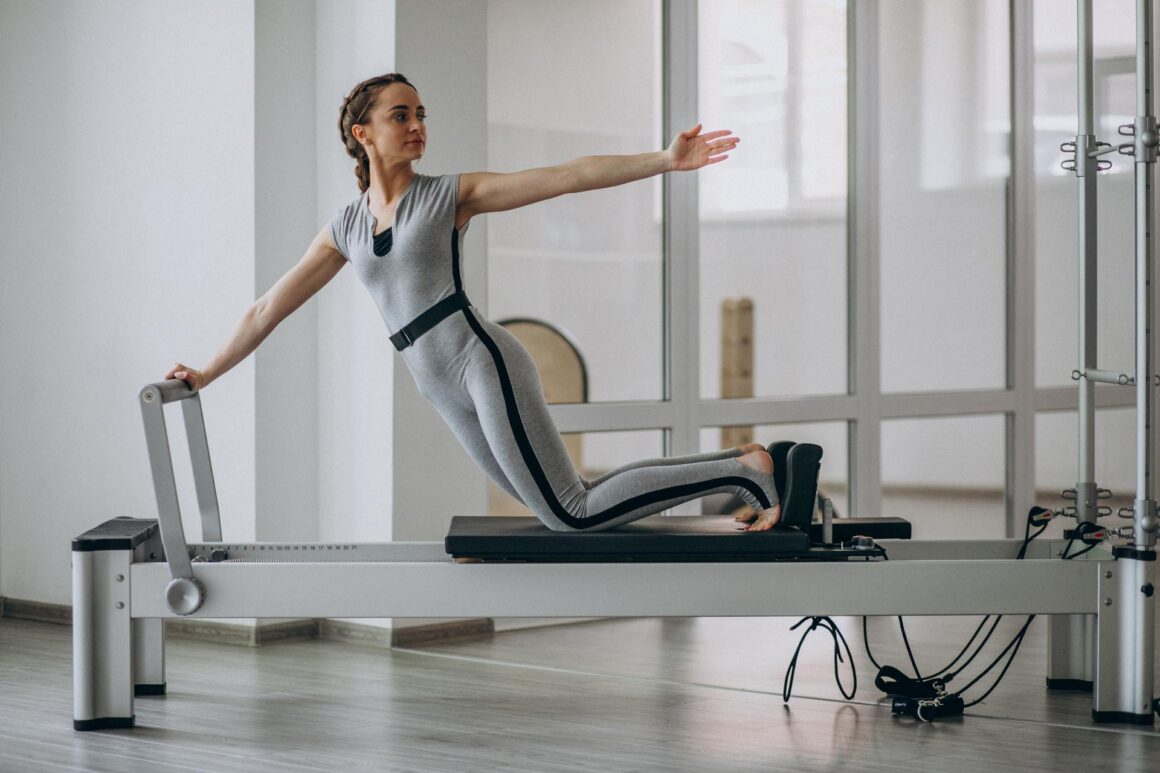
On a reformer, the spring-loaded carriage moves in response to how you move, which means your stabilizers have to stay active and adaptive throughout the full exercise, not just at its hardest point.
Exercises like footwork, long stretch, and single-leg variations ask the body to manage resistance and an unstable surface at the same time. This combination builds the kind of stability that actually carries over into everyday movement.
Some smart reformers now track movement metrics in real time, which adds a useful layer of feedback. The metrics that matter most in Pilates are:
- Control: whether your movement timing matches your instructor’s cues
- Speed: the tempo at which you move through each rep
- Consistency: whether your form holds as the set progresses
Why Is Pilates Good for Flexibility, and What Does Mobility Have to Do with It?
Pilates is well known for improving flexibility, but the more useful outcome is improved mobility, and the two aren’t the same thing.
- Flexibility is how far a muscle can lengthen passively when relaxed
- Mobility is how far a joint can move under active muscular control
Static stretching can increase passive flexibility, but the nervous system doesn’t automatically trust ranges of motion it hasn’t learned to control. That’s why someone can have genuinely long hamstrings and still move stiffly through the hips. The muscles around the joint simply lack the active control to use that range safely and comfortably.
In Pilates, as one muscle group lengthens through an exercise, the opposing group is working to control the position. Over time, the body gradually builds a usable range of motion, not just passive length.
A study from the Journal of Strength and Conditioning Research found meaningful improvements in hamstring flexibility among participants doing Pilates twice weekly. Because most Pilates exercises move through multiple joints at once, those gains tend to be distributed across the whole body rather than isolated to one area.
What Changes in Everyday Life?
The real payoff from improved balance, stability, and flexibility tends to show up in moments that have nothing to do with exercise.
People who practice Pilates consistently often notice:
- Reaching overhead or bending down without bracing against anticipated discomfort
- Catching a stumble before it becomes a fall
- Getting through a long day of sitting without the usual lower back fatigue
- Rotating to reach something (turning in the car, grabbing something off a shelf) without restriction
Athletes tend to notice it as better joint control and more reliable movement under load.
People managing chronic stiffness, or coming back from injury, often describe it as the first time in a while that movement just feels easy.
Either way, the same thing is happening underneath: the stabilizing muscles are doing their job, the joints are moving through fuller ranges without the body guarding against them, and the nervous system has a more reliable read on where everything is and how to respond.
Final Thoughts
Joseph Pilates once said: “In 10 sessions you’ll feel the difference, in 20 you’ll see the difference, and in 30 you’ll have a new body.” That quote has been passed around Pilates studios for decades, and while it sounds almost too simple, it reflects something true about how this kind of training works.
Balance, stability, and flexibility improve slowly, session by session, until you notice you’re moving through something that used to require effort or cause discomfort. You don’t always see the progress coming, but one day you just notice it’s there.

 Yplostylia Varkonin


 Heather Arranie




 Lucy Payton