How to Turn an Existing Audience Into a Product Business With Supliful
 Thraxulon Kritdel
Building an audience and building a product business used to require two very different skill sets. Today, the gap between them has narrowed. A creator, professional, podcaster, athlete, or ecommerce operator who already commands attention can use that distribution to launch a product without first building a large manufacturing and fulfillment operation.
The important distinction is that an audience does not automatically become a business. Followers, subscribers, email contacts, and community members provide access to potential customers, but the product still needs to solve a relevant problem, fit the brand, and make economic sense.
That changes the starting point. Instead of asking, “What product should I sell?”, an audience-led business can ask, “What does my audience already want, and what product naturally belongs in that relationship?”
An Audience Is a Distribution Asset
Attention has economic value because customer acquisition remains one of the hardest parts of ecommerce.
A creator with an established YouTube channel, podcast, newsletter, Instagram account, professional community, or ecommerce customer base already has a distribution channel. The audience knows the creator’s perspective, understands the topics they cover, and may already act on their recommendations.
That creates an advantage over a new ecommerce brand that has to acquire every potential customer from scratch.
Shopify has documented the broader shift from creator content toward owned businesses. As creators gain more control over their brands, many are moving audiences toward websites, stores, products, subscriptions, and other channels they control rather than relying entirely on advertising or sponsorships.
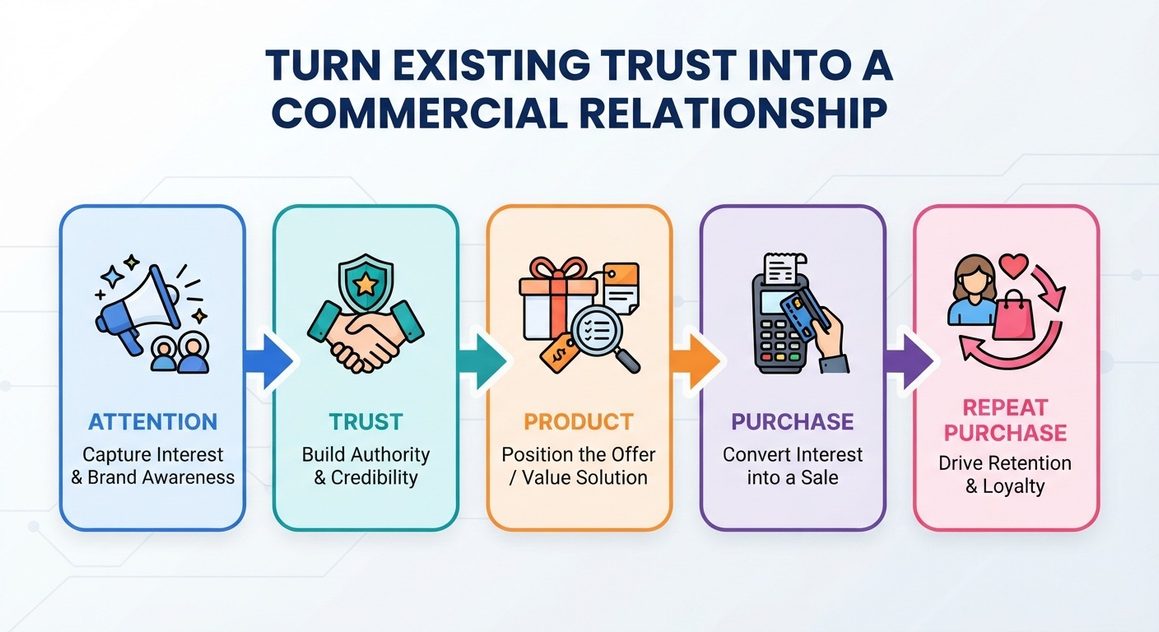
The opportunity, then, isn’t simply to monetize followers. It is to turn existing trust into a commercial relationship:
attention → trust → product → purchase → repeat purchase
That model can work particularly well when the product directly connects to the subject that built the audience in the first place.
Start With the Audience, Not the Product
A common mistake is choosing a product first and then trying to find customers for it.
An audience-led approach reverses the process.
Start by looking at what people already ask about, buy, and discuss.
A fitness creator might notice that followers regularly ask about recovery, hydration, sleep, or workout nutrition. A skincare educator could identify recurring questions about specific routines or ingredients. A productivity-focused creator may see consistent interest in energy, focus, or sleep.
Those conversations provide useful product signals.
The next step involves looking at existing commercial behavior. Affiliate clicks, sponsored-product engagement, email responses, customer purchases, direct messages, and product questions can reveal much more than follower counts alone.
The strongest opportunity usually sits where three things overlap:
- Audience interest: people already care about the problem.
- Purchase intent: people already spend money trying to solve it.
- Brand credibility: the creator has a legitimate reason to recommend a solution.
Follower count matters less than relevance. A smaller audience with strong trust and a clear commercial need can provide a better foundation for a product business than a much larger but disconnected following.
The Best First Product Usually Solves an Existing Problem
Product selection should start with a recurring problem rather than a random trend.
Consider a creator whose content revolves around fitness. Launching an unrelated household product simply because it has strong ecommerce demand creates a weak connection between the audience and the brand.
A product related to hydration, recovery, nutrition, or another established audience interest creates a much more logical proposition.
Before selecting a product, ask:
- Would my existing audience actually use this?
- Do people already spend money in this category?
- Can I explain why this product belongs under my brand?
- Can I demonstrate or discuss it naturally in my content?
- Does the product support repeat purchases?
- Can the economics support the retail price?
The answers help separate a genuine product opportunity from merchandise that merely carries a familiar logo.
Audience-product fit also gives creators a content advantage. When the product connects with the subject people already follow, the creator can educate, demonstrate, review, and discuss it without turning every piece of content into an advertisement.
Validate Demand Before Building a Full Product Operation
An existing audience gives you something a new product company would normally have to spend money acquiring: a group of people willing to provide feedback.
Use that access before making a large commitment.
A creator could run a survey, ask followers to choose between product concepts, collect email signups for a launch, publish educational content around a potential product category, or offer samples to a small group of relevant customers.
One distinction matters throughout the process:
Engagement is not demand.
A post receiving hundreds of comments about a product idea tells you that the topic interests people. Actual purchases tell you whether people will pay for the solution.
That doesn’t mean every product needs a huge pre-launch campaign. A simple test can answer useful questions:
- Which product generates the strongest response?
- Which positioning gets people to click?
- What price creates resistance?
- Which audience segment converts?
- Do customers reorder?
- What objections appear before purchase?
The objective isn’t to prove that everyone wants the product. It is to establish whether a commercially meaningful segment will pay for it.
Why Traditional Product Launches Create Friction
Turning an audience into a product business can become complicated once physical products enter the picture.
Someone who understands content, community, marketing, or ecommerce doesn’t necessarily want to negotiate with manufacturers, forecast inventory, manage packaging, operate a warehouse, or coordinate fulfillment.
Traditional product development can also force a business to commit capital before it understands demand. Minimum order quantities, production runs, storage, packaging, and shipping can create high costs before the first customer arrives.
That creates an awkward situation for an audience-led business.
You may already know how to reach potential customers, but you don’t yet know how many of them will buy.
An on-demand model changes that equation. Instead of building a large inventory position first, the business can test demand and let the operational infrastructure scale alongside actual orders.
What Is Supliful and How Does It Fit Into the Model?
Supliful is a brand-building infrastructure platform that helps businesses create and sell branded supplements, beauty products, and coffee without managing traditional manufacturing, supplier relationships, inventory, and fulfillment themselves. The company describes its role as handling the operational side of the product business while the brand owner focuses on building the brand and selling to customers.
The company grew out of its founders’ earlier ecommerce business, Grafomap, an on-demand personalized map poster service. Supliful applied a similar principle to consumer products: reduce the infrastructure required to bring a branded product to market. Supliful launched in 2021 and has since expanded its catalog, fulfillment network, and creator offering.

Supliful currently reports more than 2 million partner-brand orders fulfilled, $70 million+ in revenue generated through the platform, and 600,000+ items shipped globally. Its 2025 company timeline also reports more than 500 creator brands launched. These figures come from Supliful’s own published company information rather than an independent audit, so they provide context for the platform’s scale rather than independent performance verification.
The operating model is straightforward. A brand owner connects a store, selects products from the catalog, adds its own branding and labels, sets retail prices, and publishes the products. When a customer places an order, Supliful receives the order information, prepares the branded product, and ships it directly to the customer. The customer sees the merchant’s store name rather than a separate fulfillment operation.
The payment flow also follows the on-demand model. The customer pays the brand through its store first. Supliful then charges the connected account for the applicable product, fulfillment, and shipping costs. The difference between the retail price and those costs contributes to the brand’s margin.
For creators, Supliful currently promotes a no-MOQ model and a catalog of more than 190 branded supplements, including protein, vitamins, gummies, collagen, pre-workout, and other categories. The company says it has launched more than 500 creator brands.
That makes the platform particularly relevant to an existing audience. The creator doesn’t need to become a manufacturer simply because the audience is ready to buy a product. Supliful provides the physical product and fulfillment layer while the creator retains control over the customer-facing brand, pricing, positioning, and distribution.
Build the First Product Around the Existing Brand
Putting a logo on a product doesn’t automatically create a strong product brand.
The product should make sense within the identity that already exists.
Three types of fit matter.
Audience fit asks whether customers actually need or want the product.
Content fit asks whether the creator can naturally talk about, demonstrate, review, or use it.
Brand fit asks whether the product feels like a logical extension of the creator’s existing expertise.
Imagine a fitness educator launching a daily wellness product. The connection becomes obvious when the creator already produces content about training, recovery, nutrition, and healthy routines.
The product becomes another part of the existing conversation rather than an interruption to it.
That distinction also affects credibility. Audiences can usually recognize the difference between a product that genuinely belongs to a creator’s business and one that exists simply because someone identified a potentially profitable category.
Launch One Product Before Building a Product Line
A first launch doesn’t need a dozen SKUs.
One product can provide enough information to determine whether the concept deserves further investment.
Track the numbers that actually matter:
- Conversion rate
- Average order value
- Customer acquisition cost
- Contribution margin
- Repeat purchase rate
- Customer feedback
- Refund or support issues
- Email conversion
- Organic recommendations and mentions
Supliful’s no-MOQ model supports a relatively narrow testing approach because a brand can launch a single SKU rather than committing to a large production run. Supliful specifically describes this as a way for existing brands to gauge demand from their current audience and expand based on actual sales data.
The objective isn’t to create an impressive catalog on launch day.
The first product needs to earn the right to become the second.
Treat the Audience as a Distribution System
An existing audience can do more than provide an initial group of customers.
It can become the distribution system around the product.
Different channels can perform different jobs:
| Channel | Primary role |
| YouTube | Education and demonstrations |
| Discovery and social proof | |
| TikTok | Reach and product discovery |
| Launches and repeat purchases | |
| Podcast | Trust and deeper product discussions |
| Website | Conversion and customer ownership |
| Community | Feedback and retention |
That structure gives the creator multiple opportunities to integrate the product without relying on traditional advertising.
A fitness creator can build a routine around a product. A podcaster can discuss the problem it solves. A nutrition professional can explain the category and ingredients. An ecommerce operator can create educational content around the product’s use case.
The strongest product content doesn’t feel like an unrelated advertisement because the product already belongs to the conversation.
Shopify has highlighted a similar shift in the creator economy: creators increasingly use content as the top of a broader business funnel and move audiences toward products and owned commerce channels.
Know the Economics Before You Scale
Sales alone don’t tell you whether the product business works.
A creator should understand the economics of every order before investing heavily in additional products.
A simple contribution-margin calculation looks like this:
Revenue per order – product cost – fulfillment – processing – shipping – acquisition costs – other variable costs = contribution margin
Supliful separates product, fulfillment, processing, and shipping costs within its order economics. The company also uses product pricing and membership structures that can vary with factors such as plan and SKU volume.
The audience can improve those economics by reducing the friction involved in customer acquisition, but it doesn’t eliminate costs.
A product that generates strong engagement but leaves little contribution margin may not deserve further investment. Likewise, a product with healthy first-order economics but poor repeat purchase behavior may require a different strategy.
The goal is to understand the relationship between audience, conversion, margin, and retention before scaling the catalog.
When the First Product Works, Expand Into a Product Line
Once the first SKU demonstrates real demand, expansion becomes easier to justify.
A sensible progression looks like this:
Audience problem → first product → sales data → second product → bundle → product line
The opposite approach creates unnecessary complexity:
Trend → 15 products → inventory → hope
Supliful currently offers more than 190 branded supplement products for creators, allowing a validated product concept to expand into adjacent categories without requiring the brand owner to establish a separate manufacturing and fulfillment operation for each new SKU.
Scaling can eventually change the operational requirements. A business with substantial sales may want custom formulations, larger production runs, or alternative fulfillment arrangements. Supliful also offers custom product development to qualifying existing clients, which represents a different stage of the product lifecycle from simply testing an off-the-shelf SKU.
The important principle remains the same: let demand determine how much infrastructure the business needs.
The Real Advantage Isn’t Just “No Inventory”
Avoiding inventory is useful, but it isn’t the entire advantage.
The bigger opportunity comes from separating brand building from operational complexity.
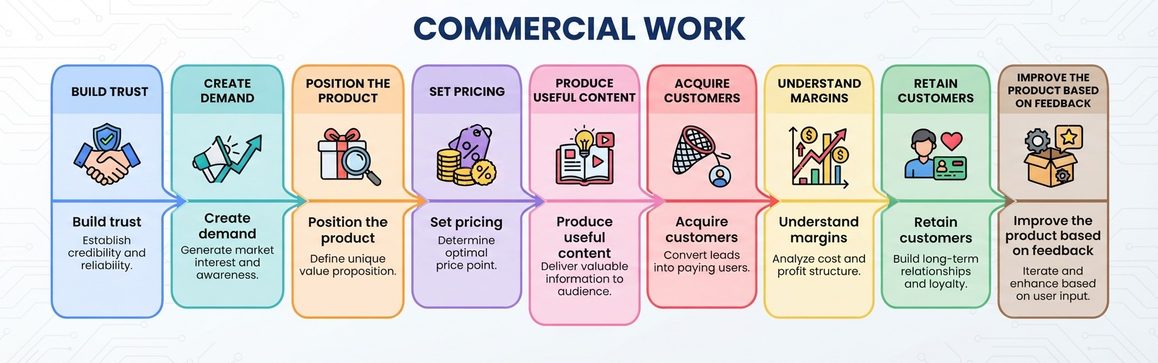
An audience owner still needs to do the difficult commercial work:
- Build trust
- Create demand
- Position the product
- Set pricing
- Produce useful content
- Acquire customers
- Understand margins
- Retain customers
- Improve the product based on feedback
Supliful doesn’t solve those problems.
Instead, it handles much of the physical infrastructure between the customer’s order and the finished product. That distinction matters. The platform can reduce operational friction, but the brand still needs a reason for customers to buy.
For an established creator or ecommerce operator, that division of responsibilities can make more sense than building an entire supply chain before proving demand.
From Existing Audience to Product Business
Turning an audience into a product business doesn’t require starting with a warehouse, a large catalog, or a major inventory commitment.
A more disciplined sequence looks like this:
- Identify a recurring audience problem.
- Find a product category that naturally addresses it.
- Confirm that people already spend money on the problem.
- Test product interest with the existing audience.
- Launch one product.
- Use existing content and distribution channels to drive initial sales.
- Measure conversion, contribution margin, and repeat purchases.
- Expand only after the first product proves itself.
An existing audience gives a new product business something valuable from day one: distribution and trust.
The next step is converting those assets into something the business actually owns.
Platforms such as Supliful can provide the product and fulfillment infrastructure behind that transition, allowing creators and established brands to concentrate on the parts of the business they already understand: audience, positioning, content, customer acquisition, and demand.

 Yplostylia Varkonin