Skip to content
Healthsciencesforum

Healthsciencesforum

Explore Supplements, Delve into Weight Loss, and Stay Informed with Health News

Connecting together in knowledge, advancing together in health

  • Home
  • Supplements
  • Weight Loss
  • Health
  • About The Team
  • Contact Us

Who does what in eye care?

Thraxulon Kritdel 6 min read
5

John F. Doane, M.D., from Discover Vision Centers, explains that many people who search for an eye doctor in Kansas City are trying to answer a basic question: do they need an optometrist, an ophthalmologist, or an optician?

The names sound similar, but the roles are not the same. One professional may check your vision and prescribe glasses. Another may diagnose and treat more serious eye disease or perform surgery. Another may help you choose frames, adjust lenses, and make sure the prescription is fitted properly.

Knowing the difference can save time. It can also help you get the right kind of care when symptoms are more than a simple prescription change.

The optometrist’s role in everyday vision care

An optometrist is often the first eye care professional people see for routine vision concerns. The National Eye Institute describes optometrists and ophthalmologists as the two basic types of eye doctors and notes that both can provide comprehensive dilated eye exams and prescriptions for glasses or contacts [1].

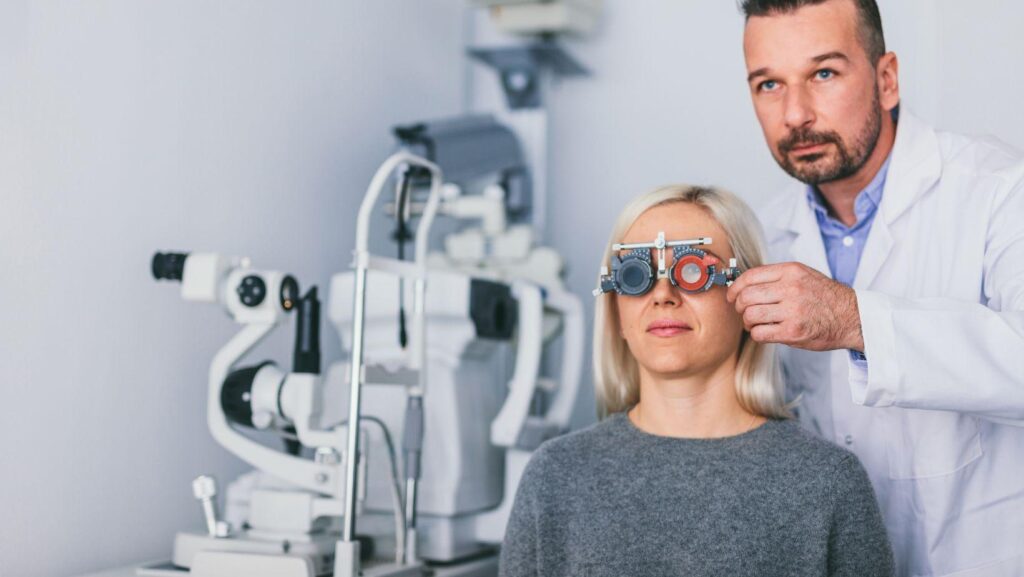
For many patients, an optometrist is the right starting point when they need a routine eye exam, an updated glasses prescription, contact lens care, or evaluation of common vision complaints. During a typical visit, an optometrist may check visual acuity, measure how well the eyes focus, evaluate eye alignment, examine eye pressure, and look for signs of eye disease.

This does not mean optometrists only prescribe glasses. Depending on state law and the patient’s needs, they may also manage certain eye conditions or refer patients for medical or surgical care. The scope of practice can vary, so the services available in one state or clinic may not be identical to those in another.

An optometrist may be the right starting point if your main concern is blurry vision that seems related to your prescription, trouble reading small print, headaches after screen use, contact lens discomfort, or needing a general eye health check. For people with diabetes, high blood pressure, a family history of glaucoma, or other risk factors, routine exams may also help identify signs that need closer medical attention.

The key is that optometry often sits at the front door of eye care. If the exam suggests something more complex, the optometrist can help guide the next step.

The ophthalmologist’s role in medical and surgical eye care

An ophthalmologist is an eye doctor who can diagnose and treat more serious eye problems. The National Eye Institute notes that ophthalmologists may offer treatments, including surgery, that optometrists do not, and that some ophthalmologists specialize in specific eye diseases such as glaucoma or diabetic retinopathy [1].

This distinction matters when eye symptoms may involve disease, injury, inflammation, or a condition that could threaten vision. Ophthalmologists evaluate and manage problems such as cataracts, glaucoma, diabetic eye disease, macular degeneration, retinal conditions, corneal disease, eye trauma, and complications from other health problems.

Some symptoms should move a person toward medical eye evaluation rather than waiting for a routine vision appointment. These include blurry vision, red or painful eyes, sudden new floaters or flashes, a sudden increase in floaters or flashes, a dark curtain or shadow moving across vision, or symptoms that start after eye surgery or an eye injury. These symptoms do not always mean a serious diagnosis, but they deserve timely attention [1,4].

Ophthalmologists also perform procedures and surgeries. Cataract surgery, refractive procedures, laser treatments for some eye diseases, glaucoma procedures, retina procedures, corneal surgery, and eyelid surgery may all fall under ophthalmic care depending on the specialist’s training and practice focus.

This is where the distinction becomes practical. If you need a new glasses prescription, you may not need a surgeon. But if the reason for blurry vision is a cataract, corneal problem, retina issue, or glaucoma-related change, an ophthalmologist may need to diagnose the cause and discuss treatment options.

Ophthalmology care is also important for patients whose eye health is tied to other medical conditions. Diabetes is a common example. The Centers for Disease Control and Prevention advises people with diabetes to get yearly comprehensive vision exams, including dilated eye exams, because diabetes-related eye problems may not cause obvious symptoms early on [2].

The optician’s role in lenses, frames, and fit

An optician is not an eye doctor. This is one of the most common points of confusion.

Opticians work with prescriptions written by optometrists or ophthalmologists. The U.S. Bureau of Labor Statistics explains that opticians help fit eyeglasses and contact lenses, following prescriptions from ophthalmologists and optometrists [3].

That role is more important than it may sound. A correct prescription still has to be made into eyewear that works for the person wearing it. Opticians help patients choose frames, explain lens options, take measurements, adjust glasses, and make sure lenses sit properly in front of the eyes. Poor fit can cause slipping frames, discomfort, distorted vision, or trouble adapting to new lenses.

Opticians may also help with lens choices based on daily needs. A person who spends long hours on a computer may ask about lens designs for near and intermediate work. Someone who drives often may ask about glare reduction. A child may need durable frames. A person with a strong prescription may need guidance on lens thickness and frame shape.

An optician’s work usually happens after the exam. They do not diagnose eye disease, perform medical eye exams, or decide whether blurry vision is caused by cataracts, dry eye, diabetes, or another condition. Their job is to help turn a prescription into eyewear that fits well and supports day-to-day vision.

For many people, the optician is the professional they spend the most hands-on time with when choosing glasses. That does not make the role medical in the same way as optometry or ophthalmology, but it does make it practical and valuable.

How the three roles may work together

Eye care is not always a straight line. Many patients move between optometrists, ophthalmologists, and opticians depending on what they need.

A common path starts with an optometrist. A patient comes in for blurry vision, expecting a new prescription. The optometrist notices cataract changes, high eye pressure, diabetic retina findings, or another concern. The patient is then referred to an ophthalmologist for medical evaluation or treatment planning.

Another path starts with an ophthalmologist. A patient has cataract surgery or receives treatment for an eye disease. After the eye heals or stabilizes, the patient may return to an optometrist for routine vision care or to an optician for updated glasses.

Sometimes all three roles are involved. A patient may see an optometrist for an exam, an ophthalmologist for a diagnosis or procedure, and an optician for glasses afterward. This is not duplication. It is a team approach, with each professional handling a different part of the process.

The National Eye Institute notes that both optometrists and ophthalmologists can provide comprehensive dilated eye exams and prescribe glasses or contacts, while ophthalmologists may also provide treatments such as surgery [1]. That overlap is one reason the roles can be confusing. The difference often comes down to the level of medical or surgical care needed.

A simple way to think about it:

  • An optometrist is often the starting point for routine vision care and many common eye concerns.
  • An ophthalmologist handles medical and surgical eye disease, especially when symptoms, risk factors, or exam findings are more complex.
  • An optician helps make and fit eyewear after a prescription is written.
  • For patients who are not sure where to start, symptoms should guide the decision. Mild prescription concerns, contact lens questions, or routine eye exams may begin with an optometrist. Sudden symptoms, eye pain, known eye disease, cataracts, diabetes-related eye concerns, or surgical questions may call for an ophthalmologist. Once a prescription is ready, an optician helps with the eyewear itself.

    For patients who need more than a basic exam, Discover Vision Centers provides optometry, medical eye care, and surgical services, so routine exams can connect with more specialized care when cataracts, glaucoma, diabetic eye disease, retina concerns, dry eye, refractive issues, or contact lens needs are identified.

    The main point is not to memorize job titles. It is important to know what kind of help each professional provides. When the right person handles the right step, eye care becomes easier to navigate.

    Post navigation

    Previous HealthSciencesForum.com: Trusted, Evidence-Based Health News And Practical Resources For 2026

    Trending

    Who does what in eye care? 1

    Who does what in eye care?

    Thraxulon Kritdel
    HealthSciencesForum.com: Trusted, Evidence-Based Health News And Practical Resources For 2026 www.healthsciencesforum .com 2

    HealthSciencesForum.com: Trusted, Evidence-Based Health News And Practical Resources For 2026

    Yplostylia Varkonin
    The Tests That Make a Medical Eye Exam Different 3

    The Tests That Make a Medical Eye Exam Different

    Yplostylia Varkonin
    How To Contact HealthSciencesForum.com: Quick, Clear Ways To Get Support In 2026 healthsciencesforum .com contact 4

    How To Contact HealthSciencesForum.com: Quick, Clear Ways To Get Support In 2026

    Yplostylia Varkonin
    How To Contact HealthSciencesForum.com: Support, Press, Contributors & Partnerships (2026 Guide) contact healthsciencesforum .com 5

    How To Contact HealthSciencesForum.com: Support, Press, Contributors & Partnerships (2026 Guide)

    Yplostylia Varkonin
    Analytical Techniques for Quality Control of BPC-157 bpc-157 quality control, bpc-157 analytical techniques, bpc-157 testing methods, peptide quality assurance, laboratory analysis bpc-157, bpc-157 purity testing, peptide validation techniques, quality analysis bpc-157, quality control protocols peptides, peptide manufacturing standards 6

    Analytical Techniques for Quality Control of BPC-157

    Thraxulon Kritdel

    Related Stories

    Analytical Techniques for Quality Control of BPC-157 bpc-157 quality control, bpc-157 analytical techniques, bpc-157 testing methods, peptide quality assurance, laboratory analysis bpc-157, bpc-157 purity testing, peptide validation techniques, quality analysis bpc-157, quality control protocols peptides, peptide manufacturing standards
    4 min read

    Analytical Techniques for Quality Control of BPC-157

    Thraxulon Kritdel 35
    What You Should Know Before Filing an Injury Lawsuit injury lawsuit tips, file injury claim, injury lawsuit process, personal injury law, injury settlement advice, injury claim attorney, injury lawsuit risks, injury claim in california, injury lawsuit legal guide, personal injury compensation
    4 min read

    What You Should Know Before Filing an Injury Lawsuit

    Thraxulon Kritdel 73
    Feel good travels: The wellness destinations that might change your life wellness travel, health retreats, wellness destinations, holistic travel, spa vacations, detox retreats, life-changing travel, mental health escapes, rejuvenation vacations, stress relief travel
    5 min read

    Feel good travels: The wellness destinations that might change your life

    Thraxulon Kritdel 100
    Eyes Up, Not Down: How AI Is Bringing Clinicians Back Into the Room ai for healthcare, clinical ai solutions, ai clinical tools, ai driven patient care, physicians ai technology, healthcare ai innovation, ai in medical consultation, ai key for clinicians, ai healthcare software, ai healthcare industry
    4 min read

    Eyes Up, Not Down: How AI Is Bringing Clinicians Back Into the Room

    Thraxulon Kritdel 111
    How To Pick A Telemedicine Agency For Your Clinic telemedicine agency, telemedicine agency selection, clinic telemedicine services, telehealth provider, telemedicine platform, healthcare technology solutions, telemedicine vendor, telehealth agency comparison, telemedicine implementation, telemedicine clinic integration
    6 min read

    How To Pick A Telemedicine Agency For Your Clinic

    Thraxulon Kritdel 132
    Troubled Teens Boot Camp vs. Therapy-Based Programs: What Works Better? troubled teens boot camp, therapy-based teen programs, teen rehab options, youth behavioral therapy, teen treatment centers, adolescent therapy programs, juvenile rehabilitation camps, teenage behavioral correction, residential teen therapy, teen mental health programs
    6 min read

    Troubled Teens Boot Camp vs. Therapy-Based Programs: What Works Better?

    Thraxulon Kritdel 104

    Popular

    Psilocybin Edibles Guide: Finest Chocolates, Gummies, and Bars in Toronto psilocybin edibles toronto, psilocybin chocolates toronto, thc gummies toronto, psilocybin bars toronto, psychedelic edibles toronto, magic mushroom edibles toronto, best psilocybin treats toronto, edible mushroom products toronto, legal psilocybin toronto, top psilocybin candies toronto
    8 min read

    Psilocybin Edibles Guide: Finest Chocolates, Gummies, and Bars in Toronto

    Yplostylia Varkonin
    Key Takeaways Chocolate bars, gummies, and teas each offer different onset times, durations, and dosing accuracy Psilobites...
    Read More
    Leading MIT Products To Try in 2026
    4 min read

    Leading MIT Products To Try in 2026

    Heather Arranie
    Kratom has evolved significantly over the last few years, moving from raw powder to highly refined extracts...
    Read More
    Rapamycin Supplement: A Deep Dive Into Its Science, Benefits, and Considerations rapamycin longevity, rapamycin anti aging, buy rapamycin, rapamycin supplements, rapamycin life extension, rapamycin aging research, rapamycin benefits, rapamycin therapy, anti aging strategies, longevity supplements
    5 min read

    Rapamycin Supplement: A Deep Dive Into Its Science, Benefits, and Considerations

    Yplostylia Varkonin
    In recent years, interest in longevity, cellular health, and anti-aging interventions has expanded rapidly. Among the compounds...
    Read More
    Daily Supplements for Men: Enhancing Your Health
    5 min read

    Daily Supplements for Men: Enhancing Your Health

    Yplostylia Varkonin
    You wake up, rub your eyes, and stare at the row of bottles on your kitchen counter....
    Read More
    healthsciencesforum.com

    Our address:

    555 Xandora Meadow, Velquain Heights, XV 44556
    Healthsciencesforum
    • Home
    • Privacy Policy
    • Terms and Conditions
    • About The Team
    • Contact Us
    Copyright © 2026 healthsciencesforum.com - All rights reserved.
    We use cookies on our website to give you the most relevant experience by remembering your preferences and repeat visits. By clicking “Accept”, you consent to the use of ALL the cookies.
    Do not sell my personal information.
    Cookie SettingsAccept
    Manage consent

    Privacy Overview

    This website uses cookies to improve your experience while you navigate through the website. Out of these, the cookies that are categorized as necessary are stored on your browser as they are essential for the working of basic functionalities of the website. We also use third-party cookies that help us analyze and understand how you use this website. These cookies will be stored in your browser only with your consent. You also have the option to opt-out of these cookies. But opting out of some of these cookies may affect your browsing experience.
    Necessary
    Always Enabled
    Necessary cookies are absolutely essential for the website to function properly. These cookies ensure basic functionalities and security features of the website, anonymously.
    CookieDurationDescription
    cookielawinfo-checkbox-analytics11 monthsThis cookie is set by GDPR Cookie Consent plugin. The cookie is used to store the user consent for the cookies in the category "Analytics".
    cookielawinfo-checkbox-functional11 monthsThe cookie is set by GDPR cookie consent to record the user consent for the cookies in the category "Functional".
    cookielawinfo-checkbox-necessary11 monthsThis cookie is set by GDPR Cookie Consent plugin. The cookies is used to store the user consent for the cookies in the category "Necessary".
    cookielawinfo-checkbox-others11 monthsThis cookie is set by GDPR Cookie Consent plugin. The cookie is used to store the user consent for the cookies in the category "Other.
    cookielawinfo-checkbox-performance11 monthsThis cookie is set by GDPR Cookie Consent plugin. The cookie is used to store the user consent for the cookies in the category "Performance".
    viewed_cookie_policy11 monthsThe cookie is set by the GDPR Cookie Consent plugin and is used to store whether or not user has consented to the use of cookies. It does not store any personal data.
    Functional
    Functional cookies help to perform certain functionalities like sharing the content of the website on social media platforms, collect feedbacks, and other third-party features.
    Performance
    Performance cookies are used to understand and analyze the key performance indexes of the website which helps in delivering a better user experience for the visitors.
    Analytics
    Analytical cookies are used to understand how visitors interact with the website. These cookies help provide information on metrics the number of visitors, bounce rate, traffic source, etc.
    Advertisement
    Advertisement cookies are used to provide visitors with relevant ads and marketing campaigns. These cookies track visitors across websites and collect information to provide customized ads.
    Others
    Other uncategorized cookies are those that are being analyzed and have not been classified into a category as yet.
    SAVE & ACCEPT