Skip to content
Healthsciencesforum

Healthsciencesforum

Explore Supplements, Delve into Weight Loss, and Stay Informed with Health News

Connecting together in knowledge, advancing together in health

  • Home
  • Supplements
  • Weight Loss
  • Health
  • About The Team
  • Contact Us

Why Nursing Schools Are Turning Away a Record Number of Qualified Applicants

Yplostylia Varkonin 5 min read
10

Modern nursing education increasingly combines classroom instruction, hands-on simulation, and digital tools that prepare students for clinical practice

Nursing has never looked like a more urgent career path, yet nursing schools just rejected more qualified applicants than ever before. U.S. nursing programs turned away 93,176 qualified applications in the 2025-2026 academic cycle, up from 80,162 the year before, according to AACN data reported by Nurse.org. That’s nearly 13,000 more rejected applicants in a single year, almost 30,000 more than two years ago.

If the country needs more nurses, why are schools sending qualified students away? The honest answer isn’t a lack of interest. It’s a lack of room.

Table of Contents

Toggle
  • The Real Bottleneck Isn’t Interest, It’s Capacity

  • Why Clinical Placements Are So Hard to Come By
  • The National Nursing Shortage Behind the Squeeze
  • How Nursing Programs Are Adapting
  • The Path Forward Isn’t Just Recruitment

The Real Bottleneck Isn’t Interest, It’s Capacity

A nursing student prepares for a clinical shift – one of thousands competing for limited placement slots nationwide

Enrollment interest in nursing hasn’t dropped. Applications keep climbing every year. What’s shrinking is the number of seats programs can actually offer, and that comes down to two constraints administrators can’t solve with a recruiting campaign: faculty and clinical placement capacity.

Clinical placement is often the first wall programs hit. Every nursing student needs supervised hours in a real clinical setting before graduating, and those hours require a hospital or clinic willing to host them. Some schools have started adopting nurse placement software to manage the limited clinical slots they already have more efficiently, matching students to available rotations faster and cutting the administrative back-and-forth that used to eat up a coordinator’s week. It’s not a fix for the underlying shortage of hospital capacity, but it does help programs get more value out of the placements they can secure.

Faculty is the other half of the equation, and it’s just as tight. Even schools that streamline their clinical scheduling still can’t grow if there’s no one to teach the extra sections. A 2025 survey of 863 nursing schools found 1,588 unfilled faculty positions nationwide, a 7.2% national faculty vacancy rate, according to the AACN Nursing Faculty Shortage Fact Sheet. Programs can’t add sections or expand cohort sizes without instructors to teach them, no matter how many applicants show up at the door.

Why Clinical Placements Are So Hard to Come By

Hospitals are stretched thin by their own staffing shortages, which leaves less bandwidth to host and supervise students on top of regular patient loads. A nurse already covering an understaffed floor has little time left to mentor a student through a shift.

Money makes the problem worse. Roughly 90% of U.S. nursing schools don’t pay their clinical preceptors, according to reporting by The Hechinger Report, which shrinks the pool of working nurses willing to take on unpaid mentorship duties. In California, more than half of nursing programs reported denied requests for clinical placements in the 2022-23 academic year, and 57.2% of the state’s 152 RN programs cited a lack of clinical placement sites as the single biggest obstacle to adding seats.

This isn’t a problem isolated to hospitals and their own staffing crunches. It ripples through the entire structure of patient care, since students need real exposure to interdisciplinary care teams to graduate ready for the floor. When placement slots dry up, students lose access to that hands-on training precisely when hospitals need well-trained new nurses the most.

Nursing programs are capped not by lack of interest, but by limited faculty and clinical placement capacity

The National Nursing Shortage Behind the Squeeze

Zoom out from any single school and the pressure gets clearer. National nursing workforce supply is projected to cover only 91.94% of demand in 2026, an 8.06% overall shortage, with the licensed practical nurse shortage running at 20% and the registered nurse shortage at 10%, according to HRSA workforce projections. The U.S. Bureau of Labor Statistics’ Registered Nurses Occupational Outlook Handbook confirms the demand side of that equation, projecting continued above-average job growth for RNs through the decade.

The exit side of the ledger looks just as troubling. Nearly 40% of actively practicing RNs, roughly 1.6 million nurses, say they intend to leave the profession by 2027-2029, and more than 138,000 nurses have already left the workforce since 2022, according to NCSBN data cited by IntelyCare. Every one of those departures adds pressure back onto the schools that are supposed to be training replacements, and every rejected applicant is a potential nurse the system won’t get in time.

Nursing sits at the intersection of science and patient care in a way few other professions do, which is exactly why the capacity problem matters beyond the classroom. A shortage of trained nurses doesn’t just show up on a staffing spreadsheet. It shows up in patient wait times, nurse burnout, and care quality.

How Nursing Programs Are Adapting
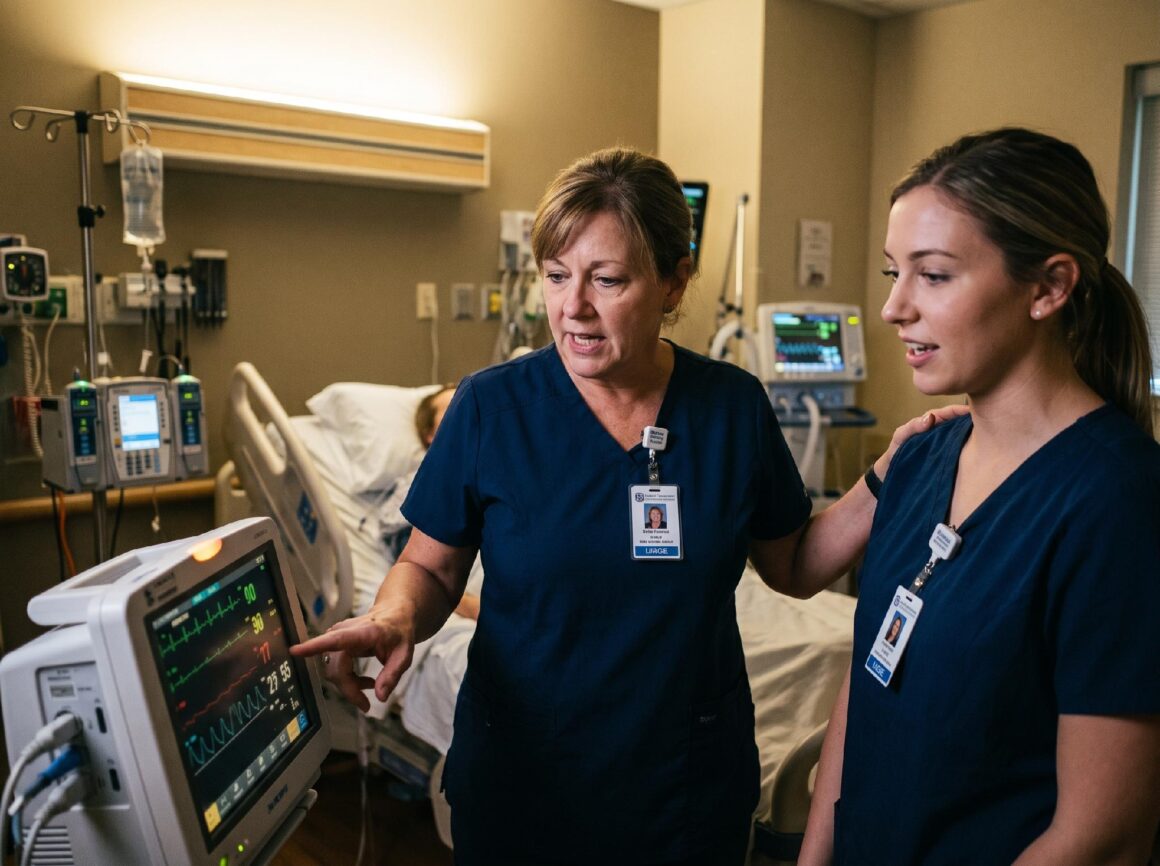
A preceptor supervises a nursing student during a clinical rotation – a resource many hospitals can no longer spare

Schools aren’t sitting still. Some have built Dedicated Education Units, where a hospital unit agrees to take a steady rotation of students from one program rather than juggling requests from several schools at once. Others have loosened simulation-hour requirements, allowing a portion of clinical hours to be completed in high-fidelity lab settings instead of live hospital shifts.

State funding has entered the picture too. California committed a five-year, $60 million grant program aimed at expanding clinical placement capacity, easing the bottleneck that’s kept its own nursing schools from growing enrollment despite steady demand. Clinical site scarcity remains one of the top reasons qualified applicants get turned away nationwide, not just in California.

Administrative coordination matters just as much as new funding. Programs juggling dozens of hospital partnerships, credentialing requirements, and compliance paperwork often lose placement slots simply because of scheduling friction, not because the slots don’t exist. Tools that centralize that coordination let program directors respond faster when a hospital opens up rotation availability, which matters when competing programs are chasing the same limited spots.

Nursing programs are increasingly turning to coordination platforms to manage scarce clinical placement slots efficiently

The Path Forward Isn’t Just Recruitment

Solving the nursing shortage was never going to be as simple as attracting more applicants. The applicants are already there, more of them every year, and schools are turning a growing share of them away. Fixing that means expanding faculty pipelines, paying preceptors fairly for their time, and helping hospitals and schools coordinate the clinical placements that turn qualified applicants into working nurses.

Programs that treat placement capacity as seriously as they treat admissions numbers will be the ones that actually grow. The rest will keep rejecting the very students the healthcare system needs most.

Post navigation

Previous When Minutes and Months Matter: The Danger of Misdiagnosing Time-Sensitive Conditions
Next What Healthcare Executives Need to Know About Integrating AI-Assisted Mental Health Into Existing Care Pathways

Trending

Which laser eye surgery options may be better for dry-eye-prone patients? 1

Which laser eye surgery options may be better for dry-eye-prone patients?

Yplostylia Varkonin
What Healthcare Executives Need to Know About Integrating AI-Assisted Mental Health Into Existing Care Pathways 2

What Healthcare Executives Need to Know About Integrating AI-Assisted Mental Health Into Existing Care Pathways

Yplostylia Varkonin
Why Nursing Schools Are Turning Away a Record Number of Qualified Applicants 3

Why Nursing Schools Are Turning Away a Record Number of Qualified Applicants

Yplostylia Varkonin
When Minutes and Months Matter: The Danger of Misdiagnosing Time-Sensitive Conditions 4

When Minutes and Months Matter: The Danger of Misdiagnosing Time-Sensitive Conditions

Thraxulon Kritdel
Why Choose Germany for Brain Tumor Treatment: Key Factors Patients Should Know 5

Why Choose Germany for Brain Tumor Treatment: Key Factors Patients Should Know

Yplostylia Varkonin
Lifestyle Diseases in India: Rising Treatment Costs and the Importance of Health Insurance 6

Lifestyle Diseases in India: Rising Treatment Costs and the Importance of Health Insurance

Yplostylia Varkonin

Related Stories

Which laser eye surgery options may be better for dry-eye-prone patients?
6 min read

Which laser eye surgery options may be better for dry-eye-prone patients?

Yplostylia Varkonin 10
What Healthcare Executives Need to Know About Integrating AI-Assisted Mental Health Into Existing Care Pathways
8 min read

What Healthcare Executives Need to Know About Integrating AI-Assisted Mental Health Into Existing Care Pathways

Yplostylia Varkonin 9
Why Choose Germany for Brain Tumor Treatment: Key Factors Patients Should Know
3 min read

Why Choose Germany for Brain Tumor Treatment: Key Factors Patients Should Know

Yplostylia Varkonin 14
Lifestyle Diseases in India: Rising Treatment Costs and the Importance of Health Insurance
4 min read

Lifestyle Diseases in India: Rising Treatment Costs and the Importance of Health Insurance

Yplostylia Varkonin 15
Hospital Bills in India: Where Most Patients Spend the Most Money
4 min read

Hospital Bills in India: Where Most Patients Spend the Most Money

Yplostylia Varkonin 15
Preventive Health Check-Ups: Why Early Screening Saves More Than Just Money
4 min read

Preventive Health Check-Ups: Why Early Screening Saves More Than Just Money

Yplostylia Varkonin 15

Popular

Psilocybin Edibles Guide: Finest Chocolates, Gummies, and Bars in Toronto psilocybin edibles toronto, psilocybin chocolates toronto, thc gummies toronto, psilocybin bars toronto, psychedelic edibles toronto, magic mushroom edibles toronto, best psilocybin treats toronto, edible mushroom products toronto, legal psilocybin toronto, top psilocybin candies toronto
8 min read

Psilocybin Edibles Guide: Finest Chocolates, Gummies, and Bars in Toronto

Yplostylia Varkonin
Key Takeaways Chocolate bars, gummies, and teas each offer different onset times, durations, and dosing accuracy Psilobites...
Read More
Leading MIT Products To Try in 2026
4 min read

Leading MIT Products To Try in 2026

Heather Arranie
Kratom has evolved significantly over the last few years, moving from raw powder to highly refined extracts...
Read More
Rapamycin Supplement: A Deep Dive Into Its Science, Benefits, and Considerations rapamycin longevity, rapamycin anti aging, buy rapamycin, rapamycin supplements, rapamycin life extension, rapamycin aging research, rapamycin benefits, rapamycin therapy, anti aging strategies, longevity supplements
5 min read

Rapamycin Supplement: A Deep Dive Into Its Science, Benefits, and Considerations

Yplostylia Varkonin
In recent years, interest in longevity, cellular health, and anti-aging interventions has expanded rapidly. Among the compounds...
Read More
Daily Supplements for Men: Enhancing Your Health
5 min read

Daily Supplements for Men: Enhancing Your Health

Yplostylia Varkonin
You wake up, rub your eyes, and stare at the row of bottles on your kitchen counter....
Read More
healthsciencesforum.com

Our address:

555 Xandora Meadow, Velquain Heights, XV 44556
Healthsciencesforum
  • Home
  • Privacy Policy
  • Terms and Conditions
  • About The Team
  • Contact Us
Copyright © 2026 healthsciencesforum.com - All rights reserved.
We use cookies on our website to give you the most relevant experience by remembering your preferences and repeat visits. By clicking “Accept”, you consent to the use of ALL the cookies.
Do not sell my personal information.
Cookie SettingsAccept
Manage consent

Privacy Overview

This website uses cookies to improve your experience while you navigate through the website. Out of these, the cookies that are categorized as necessary are stored on your browser as they are essential for the working of basic functionalities of the website. We also use third-party cookies that help us analyze and understand how you use this website. These cookies will be stored in your browser only with your consent. You also have the option to opt-out of these cookies. But opting out of some of these cookies may affect your browsing experience.
Necessary
Always Enabled
Necessary cookies are absolutely essential for the website to function properly. These cookies ensure basic functionalities and security features of the website, anonymously.
CookieDurationDescription
cookielawinfo-checkbox-analytics11 monthsThis cookie is set by GDPR Cookie Consent plugin. The cookie is used to store the user consent for the cookies in the category "Analytics".
cookielawinfo-checkbox-functional11 monthsThe cookie is set by GDPR cookie consent to record the user consent for the cookies in the category "Functional".
cookielawinfo-checkbox-necessary11 monthsThis cookie is set by GDPR Cookie Consent plugin. The cookies is used to store the user consent for the cookies in the category "Necessary".
cookielawinfo-checkbox-others11 monthsThis cookie is set by GDPR Cookie Consent plugin. The cookie is used to store the user consent for the cookies in the category "Other.
cookielawinfo-checkbox-performance11 monthsThis cookie is set by GDPR Cookie Consent plugin. The cookie is used to store the user consent for the cookies in the category "Performance".
viewed_cookie_policy11 monthsThe cookie is set by the GDPR Cookie Consent plugin and is used to store whether or not user has consented to the use of cookies. It does not store any personal data.
Functional
Functional cookies help to perform certain functionalities like sharing the content of the website on social media platforms, collect feedbacks, and other third-party features.
Performance
Performance cookies are used to understand and analyze the key performance indexes of the website which helps in delivering a better user experience for the visitors.
Analytics
Analytical cookies are used to understand how visitors interact with the website. These cookies help provide information on metrics the number of visitors, bounce rate, traffic source, etc.
Advertisement
Advertisement cookies are used to provide visitors with relevant ads and marketing campaigns. These cookies track visitors across websites and collect information to provide customized ads.
Others
Other uncategorized cookies are those that are being analyzed and have not been classified into a category as yet.
SAVE & ACCEPT